A freelance designer and a design agency can both give you good screens. They differ in who does the work, who manages it, what it costs and what happens when something goes wrong. This guide compares freelancers, agencies and in-house designers on each of those points, with freelance prices from Upwork, agency prices from Clutch and US pay data from the Bureau of Labor Statistics, all read on 2 November 2026. TechNamah is a UI/UX design and development agency, so we also say plainly when a freelancer is the better choice.
What is the difference between a UI/UX design agency and a freelancer?
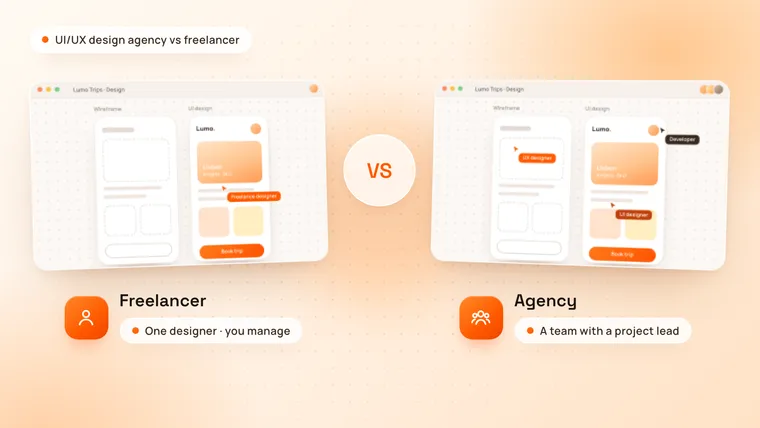
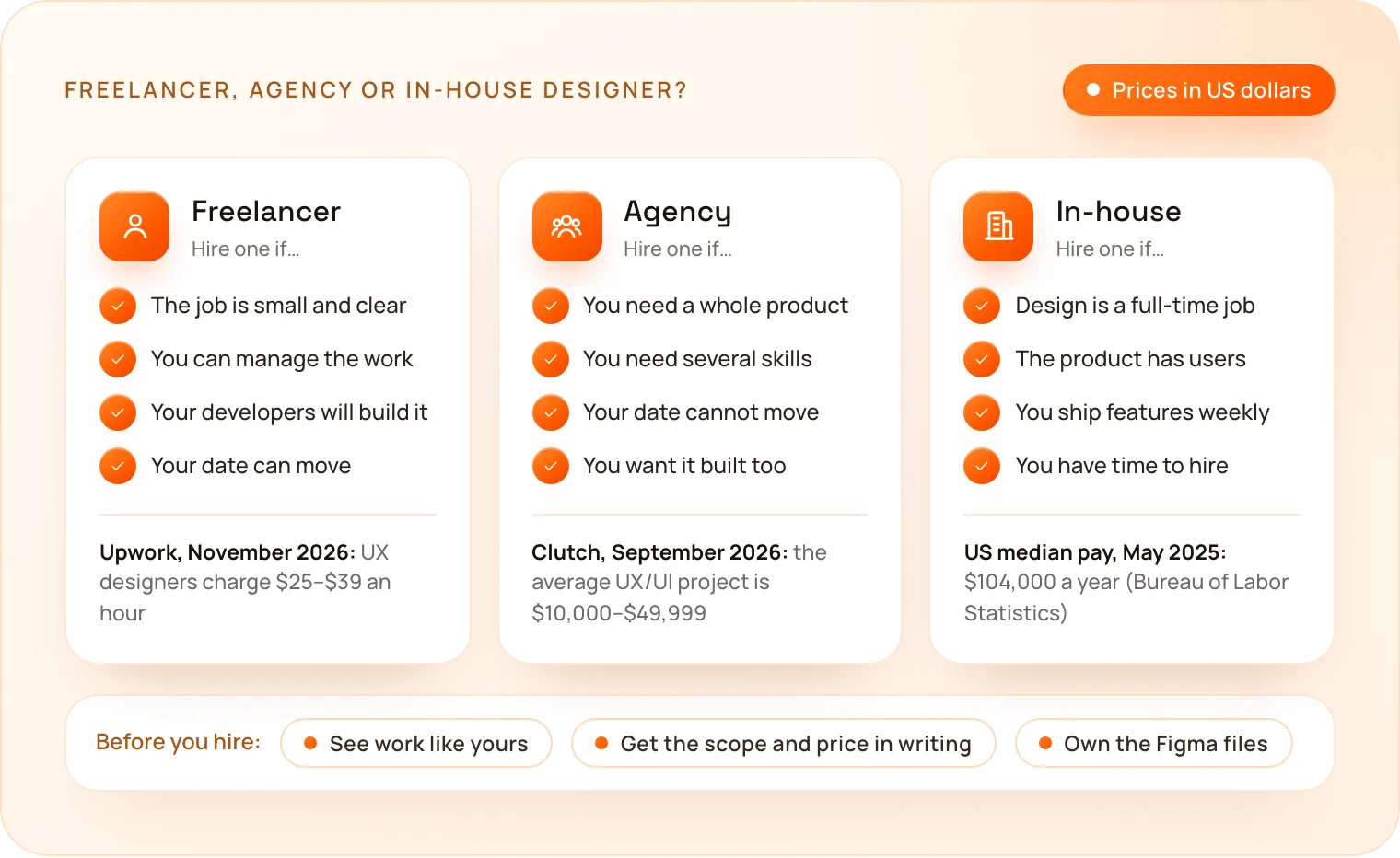
A freelancer is one designer you hire directly and manage yourself. An agency is a team, usually UX and UI designers with a project lead and often developers, that takes responsibility for the result. The third option is an in-house designer: your own employee.
| Freelancer | Agency | In-house designer | |
|---|---|---|---|
| Who does the work | One designer | A team of designers, often with developers | Your own employee |
| Who manages it | You | The agency’s project lead | You or your product lead |
| Skills | One person’s, often UI or UX | Research, UX, UI, prototyping and design systems | One person’s |
| How you pay | By the hour, or a fixed price per project | Usually a fixed price per project | A salary, plus benefits and tools |
| If they are busy or leave | The work waits or stops | Another designer continues | You hire again |
| Best for | Small, clearly defined jobs | A whole product, or a redesign with a launch date | Daily design work on a product with users |
Is a freelancer cheaper than a UI/UX design agency?
Usually for the same job, but not always by the hour. The hourly rates on Upwork and Clutch overlap; agency projects cost more mainly because they are bigger, with research, a team and project management included.
Freelance UX designers on Upwork, in US dollars:
| Freelancer | Price |
|---|---|
| Hourly rate | $25–$39 an hour |
| Usability audit | $300–$900 |
| Wireframes and prototype | $800–$2,500 |
| Full product UX design | $3,000–$12,000 |
| Design system | $4,000–$15,000 |
Upwork lists the audit and the wireframes with a clickable prototype as mid-level work, and the full product design and the design system as senior work.
Design agencies on Clutch:
| Agency | Price |
|---|---|
| Hourly rate, most agencies | $25–$49 an hour |
| Average UX/UI project | $10,000–$49,999 |
An in-house designer costs a salary instead: the median pay for web and digital interface designers in the US was $104,000 a year in May 2025.
Sources: Upwork (typical ranges for UX work on its marketplace), Clutch (its design agency pricing guide, updated 21 September 2026) and the US Bureau of Labor Statistics (web and digital interface designers), read on 2 November 2026.
The quote is not the whole cost. With a freelancer, you spend your own time on the brief, the feedback on every screen and the handoff to your developers. With an agency, a project lead does that work, and it is part of the price.
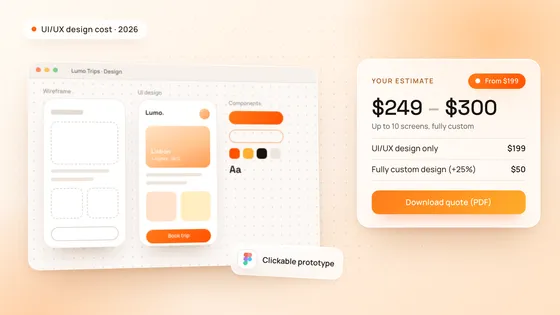
Agency prices vary too. At TechNamah, UI/UX design on its own starts at $199 for up to 10 screens, with a clickable prototype and design system basics, because we start from a proven design system and use AI across design and testing. Our guide on how much UI/UX design costs shows what that includes, with four example projects.
When should you hire a freelance UI/UX designer?
Hire a freelancer when the job is small and clear, and someone on your side can run it.
- The job is small and clearly defined, such as a usability audit, a landing page or a redesign of one flow.
- You can manage the work. Someone on your team writes the brief, reviews every screen and decides on changes.
- Your developers will build it from the designer’s Figma files.
- You have seen their work on products like yours, not only attractive screenshots.
- Your date can move if the designer is busy with another client.
When should you hire a UI/UX design agency?
Hire an agency when the job is big, needs several skills or has a date that cannot move.
- You need a whole product designed, or a redesign with many flows.
- You need several skills at once: user research, UX, UI, a clickable prototype and a design system.
- Nobody on your team has time to manage a designer, or the experience to judge the design.
- You have a launch or investor date, and the work has to continue if one person is away.
- You want one team to design and build it, with no handoff between a freelance designer and separate developers.
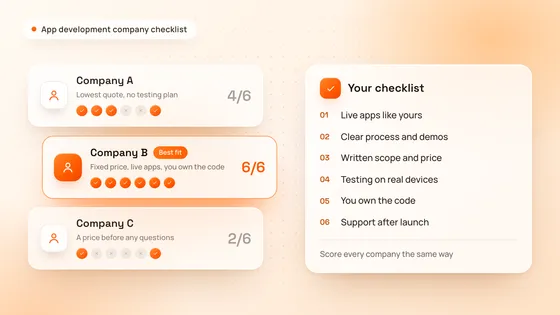
If the agency will also build your app, our guide on how to choose an app development company covers the questions about code, testing and the contract.
When does an in-house designer make sense?
Hire in-house once design is a full-time job: a product with users and new features to design every week. Before that, a salary usually costs more than the design you need. The median pay for web and digital interface designers in the US was $104,000 a year in May 2025, according to the Bureau of Labor Statistics, before benefits, tools and the time it takes to hire.
Many startups combine the options: an agency or a freelancer designs the first version, and an in-house designer takes over as the product grows. If you plan that, ask for a design system and well-organised Figma files from the start, so the new designer can pick them up.
What are the risks of each option, and how do you reduce them?
Each option fails in its own way, and each risk has a simple check.
- Freelancer. The designer may be busy with other clients, the work stops if they leave, quality varies widely and you manage the scope. See their work on products like yours, start with a small paid task, and agree milestones and the file handover in writing.
- Agency. You pay more, a senior person may sell the project while a junior designer does it, and you may get process you do not need. Ask who will design your product, get a fixed scope and price, and ask when you will see the first prototype.
- In-house. You pay a salary before you know what the product needs, hiring takes time and you get one person’s skills. Hire once design is a full-time job, and bring in outside help for research or a design system.
Whoever you hire, a small paid first step is the cheapest test. A clickable prototype of your main flow shows how they think, communicate and deliver, before you commit to the whole project.
Which questions should you ask before you hire either one?
Ask freelancers and agencies the same questions, and compare the answers side by side.
- Who will design my product? The person’s name and level, and whether they do the work day to day.
- Can I see work like mine? Live products or case studies in your category, with the problem and the result, not only screenshots.
- What exactly do I get? The number of screens, a clickable prototype, a design system and files your developers can build from.
- How is it priced? A fixed price for a written scope, or by the hour, and how changes are priced.
- How many rounds of changes are included? And what a change costs after that.
- How will we work together? The tools, the calls and how quickly they reply.
- Who owns the design files? You should get the Figma files and the rights, in writing, once you have paid.
- Who will build it? If they do not build, ask how they hand the design over to your developers.
How does TechNamah work as a UI/UX design agency?
We are a design and development agency, so here is how we compare on the points above.
- Price. UI/UX design on its own starts at $199 for up to 10 screens, with a clickable prototype and design system basics. A fully custom, brand-led design adds 25%.
- Speed to start. You get a design proposal, timeline and cost estimate within 48 hours, and the first clickable prototype of your main flow is ready in 72 hours.
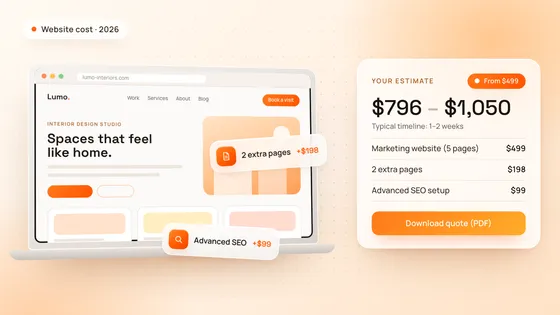
- Design and build. When we also build your website or web app or mobile app, the design is included in the price: a website from $499, a mobile app MVP from $1,499 and a SaaS MVP from $2,999.
- Your files. Once the project is paid in full, the Figma files and documentation made for you are yours, as our Terms of Service set out.
You can see our design work in the Luméa and Aivon case studies, and how we work on our UI/UX design page.
Agency or freelancer: how do you decide?
Ask three questions: how big is the job, who will manage it and who will build it. A small, clear job that you can manage, built by your own developers, suits a freelancer. A whole product, no time to manage it or a need to have it built suits an agency. Design every day, on a product with users, suits an in-house designer.
To see what an agency costs for your product, pick UI/UX design in our free app and website cost calculator, or book a free strategy call: in 30 minutes we look at your product and the screens you need, and we reply to every request within 24 hours.