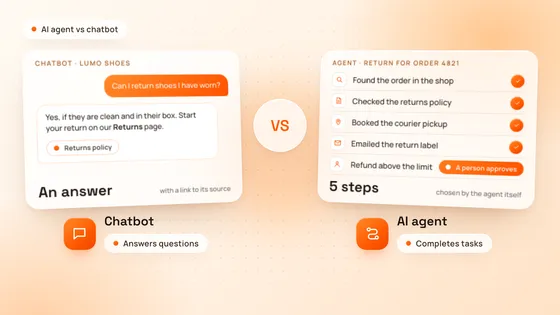
AI Agent vs Chatbot: What Is the Difference?
AI agent vs chatbot: what each one does, how they differ on actions, tools and risk, with real examples and how to tell which one your business needs.
AI Agent Development
We build custom AI agents that take a goal, plan the steps and use your tools to finish the job: research, sales prospecting, operations and back-office work, with limits you set and approval where it matters.
Our core stack
What We Build
A chatbot answers questions. An agent takes action: it searches, reads, compares, fills in forms and updates your systems until the task is done. We give each agent only the tools and data it needs, and log every step it takes.



We turn a process your team repeats, such as preparing a quote, checking an application or reconciling records, into an agent with clear instructions, the right tools and a defined finish line.
What we do:
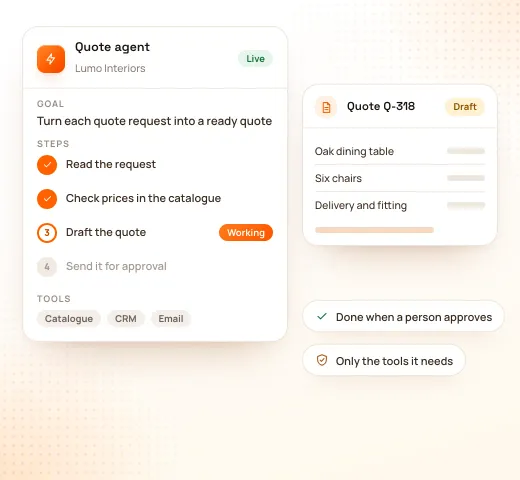
Agents that search the web and your own sources, read what they find, compare it and write a summary with links, for market research, competitor checks, supplier lists or due diligence.
What we do:
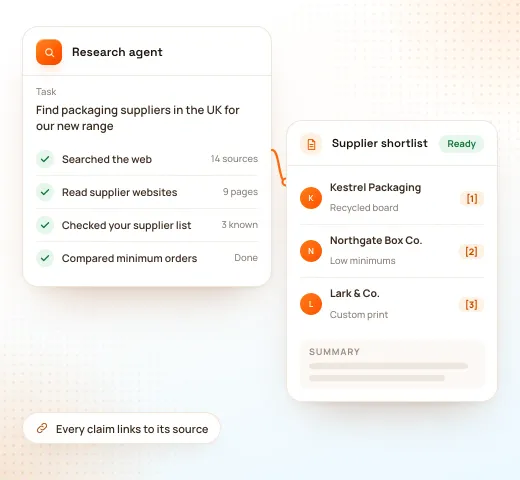
An agent that researches each new lead, checks it against your ideal customer, drafts a personal first message and adds everything to your CRM for a person to review and send.
What we do:
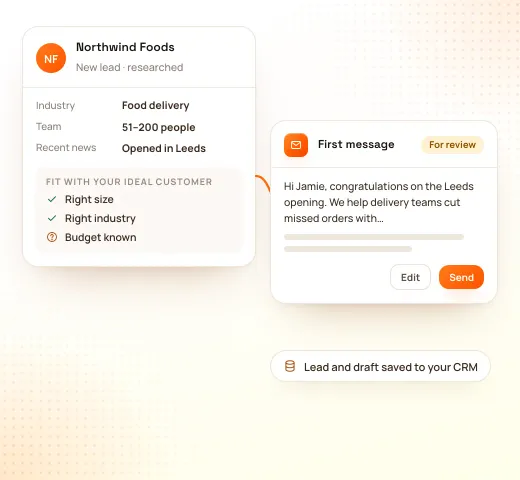
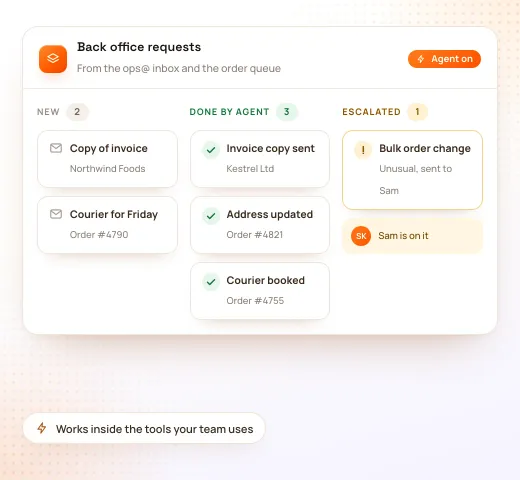
Agents that watch inboxes, queues and systems, handle routine requests from start to finish and escalate the unusual ones, working inside the workflows and tools your team already uses.
What we do:
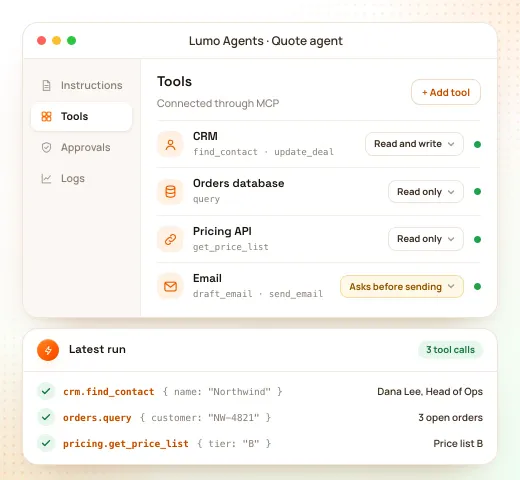
Agents connect to your CRM, databases and internal APIs through function calling and the Model Context Protocol (MCP), the open standard for connecting AI to tools and data, with access limited to what each agent needs.
What we do:
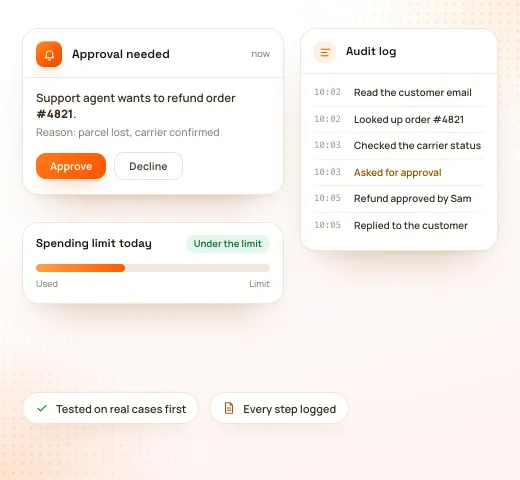
Spending limits, approval steps for actions that matter, tests on real cases before launch and a log of every step, so you can see exactly what the agent did and why.
What we do:
How We Work
An agent earns more freedom as it proves itself on real work.
A free 30-minute call on the tasks an agent could take off your team.
The goal, the tools, the limits and the steps that need a person’s approval.
A first prototype working on real examples in 72 hours.
Measured on a set of real cases, with failures fixed before launch.
Live with approvals and logs, then given more autonomy as results allow.
Why Choose Us
An agent acts for your business, so it has to be useful, predictable and easy to check.
We test agents on real cases and measure them before they touch live work.
Actions that matter wait for a person, and every step is logged.
Every system handles 10× the current load, so one agent can grow into many.
We use OpenAI, Anthropic or Google models and switch when a better fit arrives.
Code, prompts and documentation are yours once the project is paid in full.
From our blog
AI agent vs chatbot: what each one does, how they differ on actions, tools and risk, with real examples and how to tell which one your business needs.
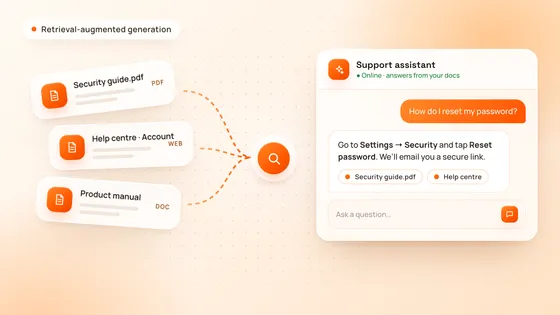
RAG lets an AI assistant answer from your own documents instead of guessing. How retrieval-augmented generation works, when you need it, and RAG vs fine-tuning.
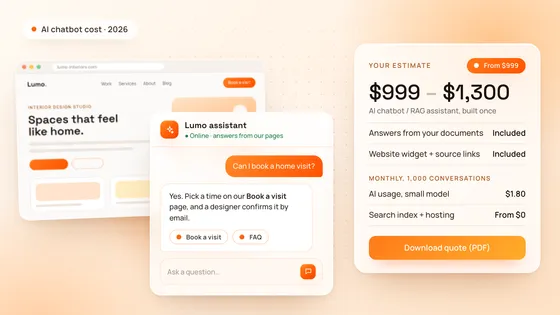
What an AI chatbot costs in 2026: from $999 for a custom assistant that answers from your documents, plus monthly AI usage, tool prices and real examples.
Got Questions
An AI agent is software that uses an AI model to work towards a goal: it decides the next step, uses tools such as search, your CRM or your database, checks the result and continues until the task is done or it needs a person.
A chatbot answers questions in a conversation. An agent takes actions across several steps, such as researching a lead, updating records or preparing a document. Many products combine both: a chatbot on the front and agents doing the work behind it.
We give each agent only the tools and data it needs, set limits on what it can do, require a person’s approval for actions that matter and log every step. Before launch we test it on real cases and fix the failures.
We pick for the job: frameworks such as LangChain or the providers’ own agent tools, models from OpenAI, Anthropic or Google, and MCP or your APIs for tools. Keeping the agent model-agnostic means you can switch models as better ones arrive.
You can see a first prototype working on real examples within 72 hours. The timeline for the full agent depends on the tools and approvals it needs, and we agree it with you on the strategy call.
Yes. Once the project is paid in full, the code, prompts and documentation made for you are yours, as our Terms of Service set out, and the agents run on your own accounts.
Ready to Start?
Book a free 30-minute strategy call and tell us which tasks you want off your team’s plate. We reply to every request within 24 hours.