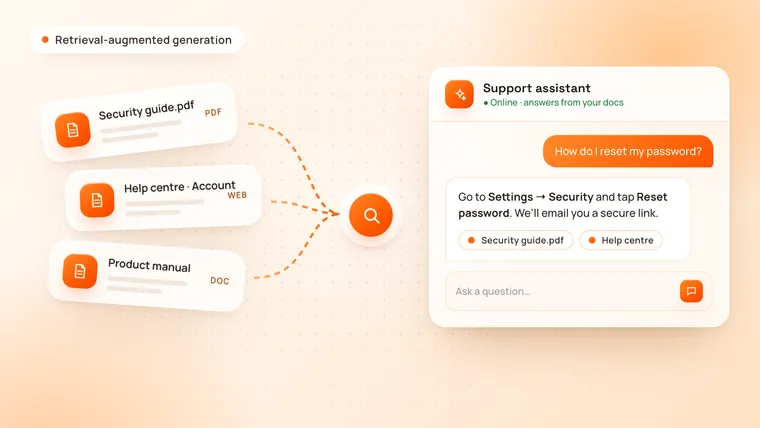
Large language models are impressive, but on their own they only know what they learned during training. They do not know your prices, your policies or last week’s product update, and when they do not know, they sometimes make an answer up. Retrieval-augmented generation (RAG) fixes this by letting the AI look things up in your own content before it answers.
What is RAG in simple terms?
RAG is an open-book exam for AI. Instead of answering from memory, the AI first finds the right pages in your own material and then writes its answer from them. The “retrieval” part finds the information; the “generation” part writes the reply.
How does RAG work?
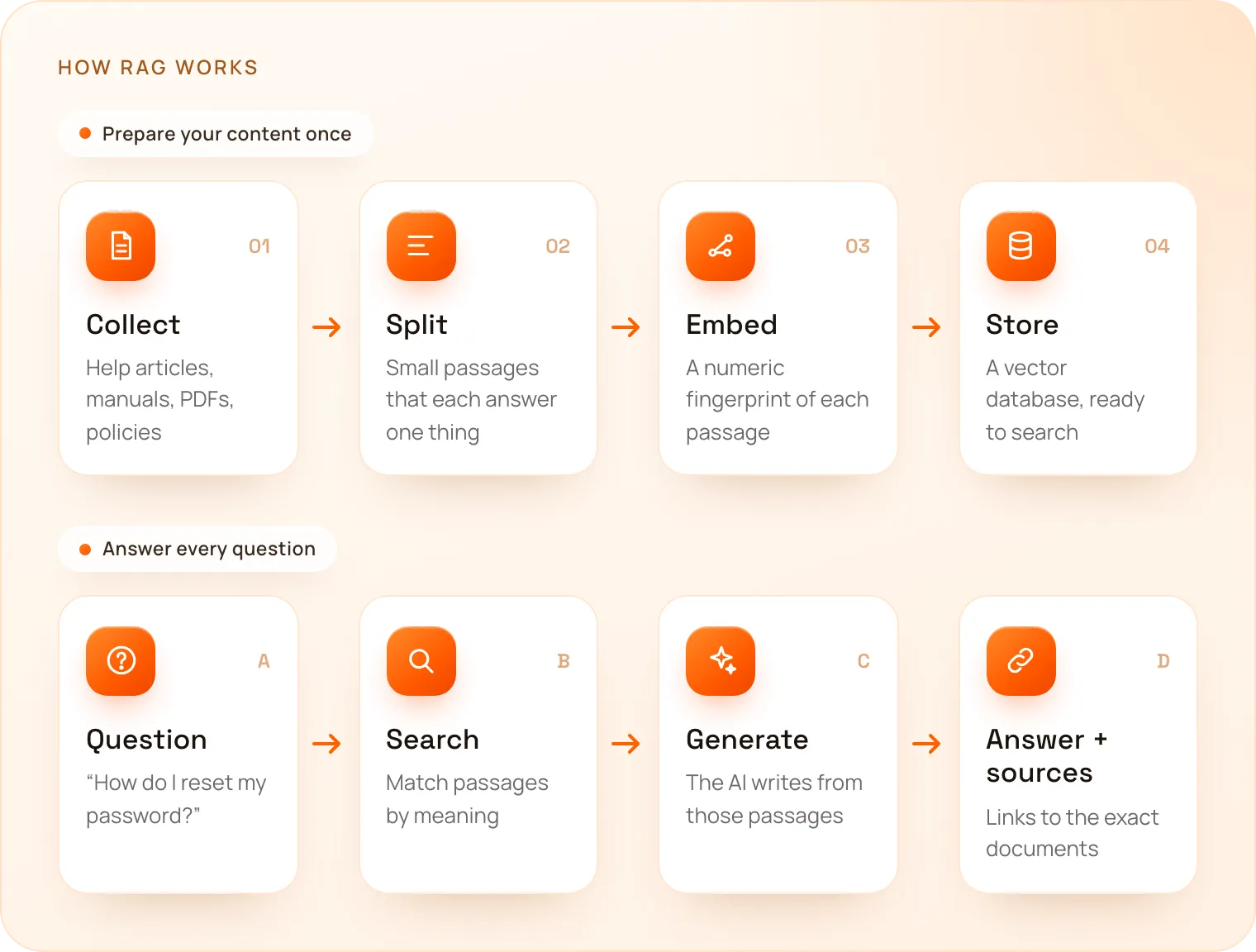
A RAG system works in two parts: preparing your content once, and answering each question.
Preparing your content:
- Collect the documents the assistant should know: help articles, manuals, PDFs, policies, web pages.
- Split them into small passages, so the system can find the exact part that answers a question.
- Index each passage as an embedding, a numeric fingerprint of its meaning, stored in a vector database.
Answering a question:
- Search. The user’s question is turned into the same kind of fingerprint and matched against your passages by meaning, not just keywords.
- Select. The most relevant passages are picked, and often re-ranked so only the best ones are used.
- Generate. The AI model writes the answer using those passages and is told to stay within them.
- Cite. The answer links to the sources it used, so people can check it.
Why do businesses use RAG?
RAG is popular because it makes AI useful for real company questions:
- Accurate, specific answers about your own products, services and rules.
- Always up to date. Change a document and the next answer reflects it, without retraining anything.
- Trust through sources. Every answer can show where it came from.
- Control. You decide exactly what content the assistant can use, and who can see what.
What is the difference between RAG and fine-tuning?
RAG gives the model the right information at question time; fine-tuning changes how the model itself behaves. Most business assistants need RAG first, and only some need fine-tuning on top.
| RAG | Fine-tuning | |
|---|---|---|
| What it changes | What the model reads before answering | The model’s own behaviour and style |
| Best for | Facts that change: products, prices, policies, documents | A consistent tone, format or specialised task |
| Keeping it current | Update the documents | Train the model again |
| Shows sources | Yes | No |
| Typical first step | Yes, for most business assistants | Usually later, if needed |
When do you need RAG?
You likely need RAG if you want an AI assistant that:
- Answers customers from your help centre, product docs or policies.
- Helps your team find information across internal documents, wikis and tools.
- Supports sales with accurate product, pricing and case-study details.
- Must show its sources because the answers need to be checked or trusted.
You probably do not need RAG for general writing help, brainstorming or tasks that do not depend on your own information.
What makes a RAG system work well?
Good RAG depends less on the AI model and more on the basics:
- Clean, current content. The assistant can only be as good as the documents it reads.
- Good search. Sensible passage sizes, search by meaning plus keywords, and re-ranking.
- Clear rules. Answer only from the sources, say “I don’t know” when the answer is missing, and hand over to a person when needed.
- Permissions. People should only get answers from content they are allowed to see.
- Testing. A set of real questions with known answers, checked every time the system changes.
TechNamah designs and builds RAG systems, from customer-support assistants to multi-source knowledge tools. See our AI services or tell us about your use case.