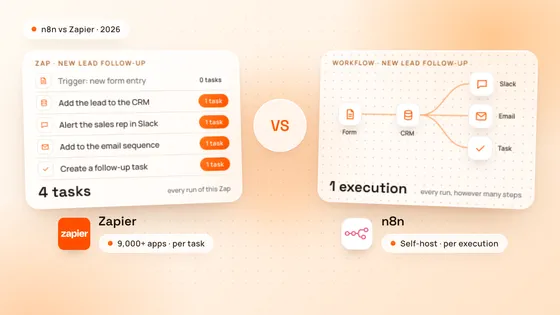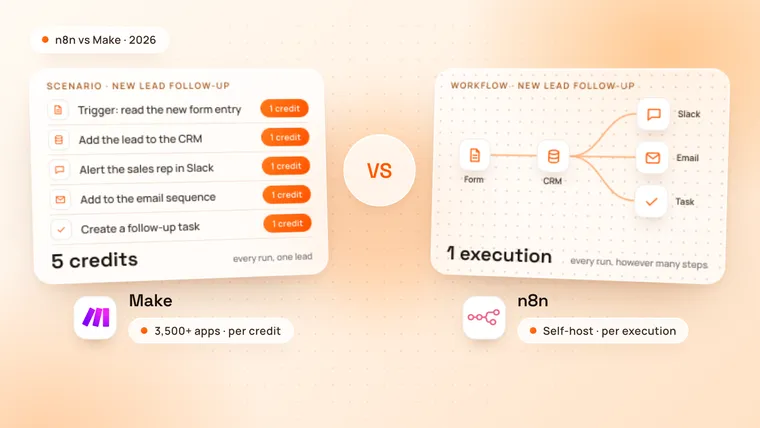
n8n and Make both connect your apps on a visual canvas, so leads, orders and messages move between them without anyone copying and pasting. They differ in how they charge, where they run and how much code they let you use. This guide compares the two on price, integrations, ease of use, self-hosting and AI, with plans checked on make.com and n8n.io on 17 November 2026.
What is the difference between n8n and Make?
Make, formerly Integromat, is a hosted, visual automation platform. You build a scenario from modules on a canvas, with routers to branch, filters to stop or pass data and iterators for lists, and it runs in Make’s cloud. n8n is a workflow automation tool for technical teams: you connect nodes on a canvas, add code where you need it and run it on n8n Cloud or on your own server.
The biggest difference is how each one counts your usage. Make counts credits: most module actions use one, including the module that reads the data a scenario starts with. n8n counts an execution for every run of a whole workflow, however many steps it has and however much data it processes.
| Make | n8n | |
|---|---|---|
| Billed by | Credits: about one per module action | Executions: one per workflow run |
| Free option | Free plan, 1,000 credits a month, two active scenarios | Free self-hosted Community edition |
| Cheapest paid plan | Make Plan, $9 a month billed yearly (5,000 credits) | Starter, €20 a month billed yearly (2,500 executions) |
| Integrations | More than 3,500 apps | More than 2,000, plus any app with an API |
| Where it runs | Make’s cloud only, in a US or EU data centre | n8n Cloud or your own server |
| Custom code | Make Code app, JavaScript or Python, on paid plans | Code node, JavaScript or Python, on every plan |
| Users | Unlimited on every plan | Unlimited on every plan |
| Best for | Short visual automations between popular apps | Long, high-volume or AI workflows |
How does Make pricing work?
Make charges by credits. Every time a module in a scenario performs an action, such as reading a record, adding a row to a sheet or sending a message, it uses a credit, and the module that reads the data a scenario starts with counts too. Routers and error handlers use none, as Make’s pricing page explains. Steps that run on Make’s own AI provider also use credits for the AI tokens they process, and the Make Code app uses 2 credits for every second its code runs.
Make has three plans. Free gives you 1,000 credits a month and two active scenarios, and its scheduled scenarios run at most once every quarter of an hour. The paid Make Plan is one plan in many sizes: you choose how many credits a month you need, and the price per 1,000 credits falls as you buy more. Enterprise adds an on-prem agent for apps inside your own network, round-the-clock support and protection against overage charges.
When you run out of credits, your scenarios stop until you add more, and incoming webhooks wait in a queue. You can buy extra credits in bundles of 1,000 or 10,000, or move up a size. On yearly billing, Make gives you the year’s credits up front, and they expire after a year instead of at the end of each month.
How does n8n pricing work?
n8n charges by executions. An execution is one run of a whole workflow, “regardless of complexity”, as n8n’s pricing page puts it: a workflow with 3 nodes and one with 30 nodes, or a run that handles one record and a run that handles a thousand, each count once. Every n8n plan includes unlimited users, unlimited workflows and every integration.
Schedules count as runs. By n8n’s own estimate, a workflow that runs every five minutes uses about 8,600 to 8,900 executions a month, and a daily one uses 30 or 31.
You can also self-host n8n. The Community edition, the standard self-hosted version, is free. You pay for the server it runs on, and someone has to install it, update it and back it up.
Which is cheaper, n8n or Make?
It depends on how many steps your workflows have and how much data each run handles. Make is often cheaper for short scenarios at low volume. n8n is cheaper when workflows have many steps, or when one run processes many records, because Make counts every action on every record and n8n counts the run.
These are the plans as of November 2026, billed yearly, before tax:
| Plan | Price | What you get |
|---|---|---|
| Make Free | $0 | 1,000 credits a month, two active scenarios |
| Make Plan | From $9 a month | 5,000 credits a month; $16 for 10,000, $29 for 20,000, $53 for 40,000, $91 for 80,000 |
| Make Enterprise | Custom | On-prem agent, round-the-clock support, overage protection |
| n8n Community, self-hosted | Free | The standard n8n, on your own server |
| n8n Starter, Cloud | €20 a month | 2,500 executions a month |
| n8n Pro, Cloud | €50 a month | 10,000 executions a month (€120 for 50,000), admin roles, workflow history |
| n8n Business, self-hosted | €667 a month | 40,000 executions a month, SSO and LDAP, queue mode for scaling |
Source: Make pricing and n8n pricing. Billed monthly, Make’s 5,000 credits cost $10.37, and n8n Starter and Pro cost €24 and €60. n8n lists its prices in euros: at the European Central Bank’s rate for 16 November 2026, €1 was $1.1014, so €20 is about $22.
The gap shows when you count a real workload. Make’s credits are the trigger plus the actions, for every record; n8n’s executions are the runs alone:
| Workflow | Make credits a month | Make, per year | n8n executions a month | n8n Cloud, per year |
|---|---|---|---|---|
| Lead follow-up: 400 leads, 4 actions each | 2,000 | $108 (5,000 credits) | 400 | €240, about $264 (Starter) |
| Orders: 2,000 orders, 7 actions each | 16,000 | $348 (20,000 credits) | 2,000 | €240, about $264 (Starter) |
| Data sync: 20,000 records a month, 3 actions each, one run a night | About 60,000 | $1,092 (80,000 credits) | 30 | €600, about $661 (Pro) |
| A simple alert: 90 runs, 1 action each | 180 | $0 (Free) | 90 | €240 (Starter), or free self-hosted |
The data sync shows the biggest difference. In Make, each of the 3 actions runs once for every record, so 20,000 records use about 60,000 credits however you schedule them. In n8n, one run a night that handles the day’s records counts once, so the month is 30 executions. It sits on Pro because n8n stops a Starter run after five minutes and a Pro run after forty, so a long nightly sync needs Pro.
Make costs less for the lead follow-up and the alert: short scenarios at low volume fit its smallest size, and its free plan covers small jobs that n8n Cloud charges for. You can also buy Make credits in bundles of 1,000 instead of moving up a size, which can lower the cost of the orders example.
On self-hosted n8n, the Community edition has no plan fee at all, so the cost is the server and the time to run it. That is often the cheapest option at high volume, if someone on your team or your agency looks after it.
Is n8n or Make easier to use?
Make is easier for people who do not write code. A scenario is a row of round modules on a canvas: you map data from one app’s fields into the next by dragging, and routers, filters, iterators and aggregators handle branches and lists without code. Maia, Make’s AI assistant, builds and debugs scenarios with you in a chat.
n8n takes longer to learn but shows more. Each workflow is a canvas of connected nodes, you can see the data that passes through every node, and expressions and the Code node let you shape data in JavaScript or Python. n8n Cloud includes Assistant, in preview, with a monthly allowance of credits (1,600 a month on Starter). Self-hosting needs someone who can run a server.
Both editors are visual, so the gap is smaller than between n8n and Zapier. The real difference is code: Make keeps it optional and charges credits for it, while n8n includes it in every plan.
Which has more integrations, n8n or Make?
Make has more ready-made integrations: more than 3,500 apps, according to Make. n8n lists more than 2,000 integrations on n8n.io.
Both reach apps that have no ready-made module. Make’s HTTP app and n8n’s HTTP Request node call any app with an API, and both let you build your own: custom apps in Make, custom nodes on self-hosted n8n. n8n’s HTTP Request node can also import a cURL command, and its Code node runs JavaScript or Python. Before you choose, check that the apps you use most have the triggers and actions you need on both.
Can you self-host n8n or Make?
Only n8n. Make runs only in Make’s cloud: when you create an organisation, you choose whether Make stores and processes its data in the US or the EU, and you cannot change it later, as Make’s help centre explains. Make Enterprise adds an on-prem agent that reaches apps inside your own network, such as SAP, but your scenarios still run in Make’s cloud.
n8n runs on your own server with Docker or npm, or on n8n Cloud, which stores its data in the EU, on servers in Frankfurt, Germany. Self-hosting matters when your data has to stay on your own infrastructure, for example because of client contracts, GDPR or health and finance rules. On the Community edition it also means no fee per run: the limit is what your server can handle.
Self-hosted n8n is free under n8n’s Sustainable Use License, which n8n also calls its Community license. You can use it to run your own business, and an agency can build and maintain workflows for you and charge for that work. It does not allow hosting n8n as a service where your customers build their own workflows, or white-labelling n8n; both need a commercial licence, as n8n’s license FAQ explains.
Which is better for AI automation and AI agents?
Both now build AI into the workflow, and they charge for it differently.
- Make: Make AI Agents, in beta, and the AI Toolkit run on Make’s own AI provider, which charges credits for the AI tokens each step uses, or on a connection to your own model provider, which you pay directly, as Make’s help centre explains. The AI Content Extractor pulls structured data out of files, and Make’s MCP server lets AI assistants run your scenarios.
- n8n: the AI Agent node works with models such as OpenAI or Claude, uses tools, connects to MCP servers and can wait for a person to approve a tool call before it runs. Because n8n bills a whole run as one execution, an agent that reads an email, looks up the customer, drafts a reply and waits for approval still counts once. On self-hosted n8n you connect your own model provider and pay it directly; n8n Cloud also offers AI models without an API key of your own.
For AI agents that call several tools in one run, n8n is usually the better fit. For an AI step inside a short visual scenario, Make is quick to set up. To ground an agent’s answers in your own documents, see our guide to what RAG is, and for budgets, how much an AI chatbot costs.
When should you choose Make?
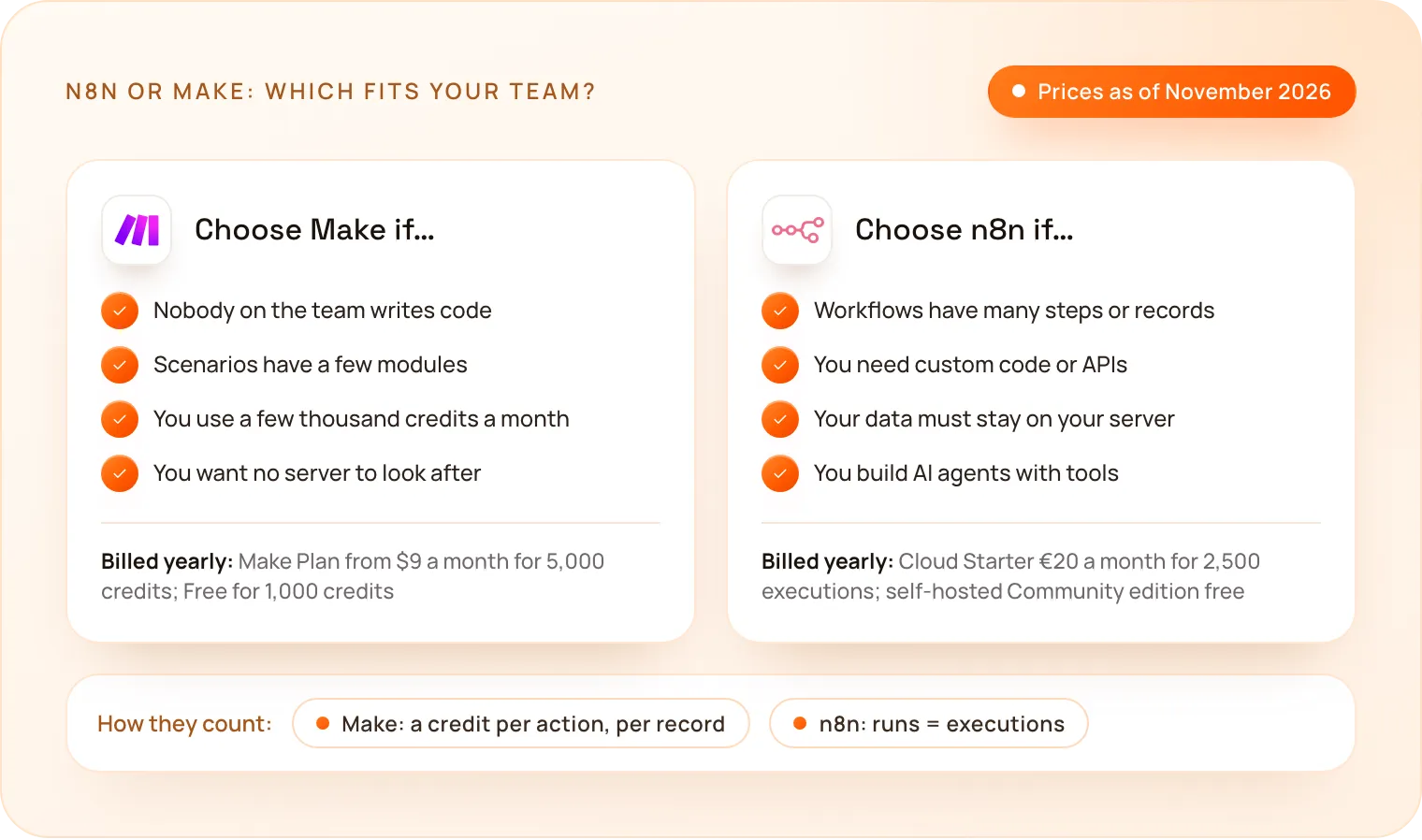
- Nobody on your team writes code, and you want to build and change automations yourselves.
- Your scenarios are short, with a few modules each.
- Your volume is low or medium, a few thousand credits a month.
- You need an app that Make connects to and n8n does not.
- You do not want to look after a server or a hosting plan.
When should you choose n8n?
- Your workflows have many steps, or one run handles many records.
- You need custom code or APIs, with no extra charge for code steps.
- Your data must stay on your own server, for example for GDPR or client contracts.
- You are building AI agents that call several tools in one run.
- Your volume will grow, and you would rather pay per run than per action.
How does TechNamah build automations?
TechNamah builds workflow automations for growing teams in n8n, Make, Zapier or code, and chooses for each job: leads into the CRM, documents into data, AI agents with a person approving the important steps, and custom APIs where a tool has no ready-made module. When a team already runs Make and its scenarios are short, we build there. When workflows are long, high-volume or AI-heavy, or must run on your own server, we recommend n8n. Once the project is paid in full, the workflows are yours, with their documentation.
See our n8n workflow automation and AI automation pages for what we build. If you are also weighing Zapier, read n8n vs Zapier.
How do you choose between n8n and Make?
Count three numbers for your main workflows: the actions in each one, the records each run handles and the runs a month. In Make, every action on every record uses a credit, and so does the trigger; in n8n, the runs alone are your executions. Then decide where your data may live and who will look after the workflows. If the numbers are small and nobody on the team writes code, start with Make. If they are large, or the workflows need code, AI agents or your own server, choose n8n. Book a free strategy call: in 30 minutes we map your workflows and recommend the right tool, and we reply to every request within 24 hours.