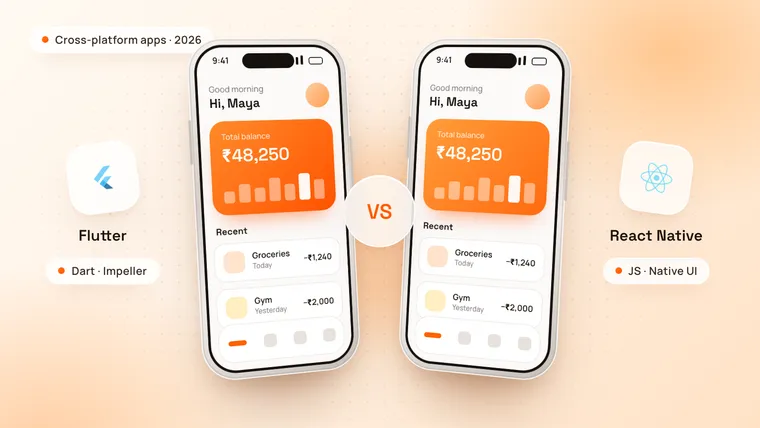
Flutter and React Native are the two most popular ways to build one app for both iPhone and Android. Both save you from building and maintaining two separate native apps. They take very different approaches, though, and the right choice depends on your product and your team.
What is Flutter?
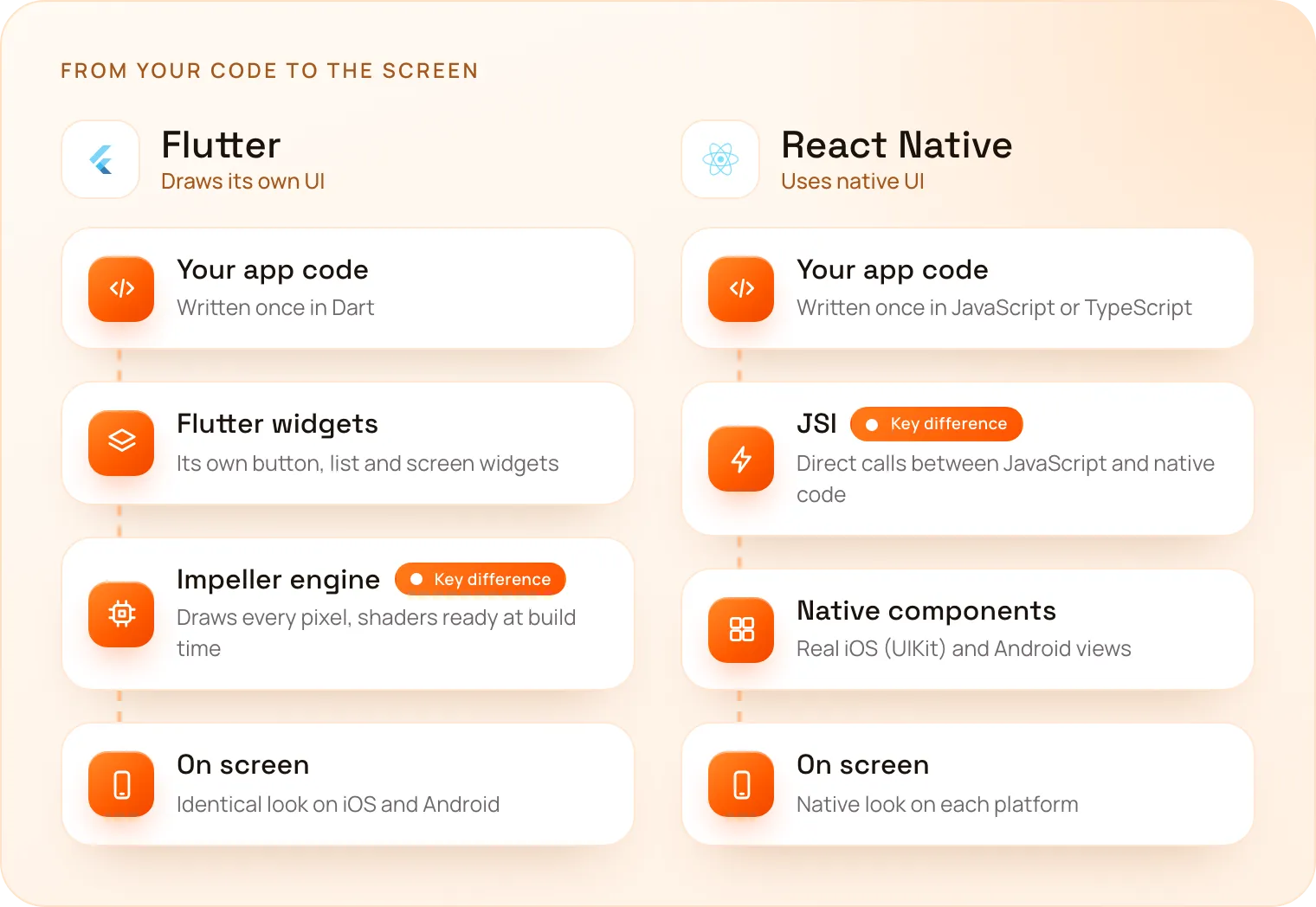
Flutter is Google’s open-source framework for building apps for iOS, Android, web and desktop from one codebase. You write the app in the Dart language, and Flutter draws every button, list and animation itself instead of using the phone’s built-in components.
Since Flutter 3.27, its Impeller rendering engine is the default on iOS and on Android API 29 and newer. On iOS, Impeller is now the only renderer. Impeller prepares its shaders when the app is built, which removes the stutter that older Flutter apps could show the first time an animation ran.
What is React Native?
React Native is Meta’s open-source framework for building iOS and Android apps with React and JavaScript or TypeScript. Instead of drawing its own interface, it turns your React components into the platform’s real native components, so a button is a true iOS button on an iPhone and a true Android button on Android.
Since version 0.76, React Native’s New Architecture is on by default. It replaces the old asynchronous bridge between JavaScript and native code with JSI, which lets JavaScript call native code directly, together with a new renderer (Fabric) and on-demand native modules (TurboModules).
How do Flutter and React Native compare?
| Flutter | React Native | |
|---|---|---|
| Made by | Meta | |
| Language | Dart | JavaScript or TypeScript (React) |
| How the UI is drawn | Its own engine (Impeller) draws every pixel | Real native iOS and Android components |
| Look across platforms | Identical on every device | Follows each platform’s native style |
| Performance | Very consistent, strong for animation-heavy UI | Fast for most business apps since the New Architecture |
| Platforms | iOS, Android, web, Windows, macOS, Linux | iOS and Android, plus web (React Native Web) and Windows and macOS (Microsoft’s out-of-tree projects) |
| Sharing with a website | Separate from a React website | Shares logic, tools and people with React web apps |
| Hiring | Smaller pool of Dart developers, growing fast | Large pool of JavaScript and React developers |
Which is better for performance?
For most business apps, both are fast enough that users will not feel a difference. Flutter has the edge in consistency: because it controls every pixel, complex animations and custom screens behave the same on cheap and expensive phones alike. React Native’s New Architecture removed its biggest old bottleneck, the bridge, so everyday screens such as lists, forms and dashboards run smoothly.
Where performance really matters, the quality of the code, the size of images and the number of network calls make a much bigger difference than the choice of framework.
When should you choose Flutter?
Flutter is usually the better choice when:
- Your design is custom and brand-led. You want the app to look exactly the same on iOS and Android.
- The app is animation-heavy. Onboarding flows, charts, games-like interactions or rich transitions.
- You are starting fresh. There is no existing React codebase or team to reuse.
- You may target more platforms later. Flutter supports web and desktop officially from the same codebase.
When should you choose React Native?
React Native is usually the better choice when:
- Your team already knows React. Your developers can start on day one without learning Dart.
- You have a React website. You can share business logic, tools and people between web and mobile.
- You want each platform’s native feel. Users get the exact controls they know from iOS or Android.
- You rely on JavaScript libraries. You can reuse much of the npm ecosystem.
What does TechNamah recommend?
TechNamah is Flutter-first: we build most iOS and Android apps in Flutter because one codebase gives our clients a consistent, polished experience on both platforms and is simpler to maintain. That said, the best framework is the one your team can grow with. If your company already runs on React, React Native can be the smarter long-term choice, and we will say so in our first conversation.
If you are planning an app and want a clear recommendation for your case, see how we approach mobile app development or get in touch.